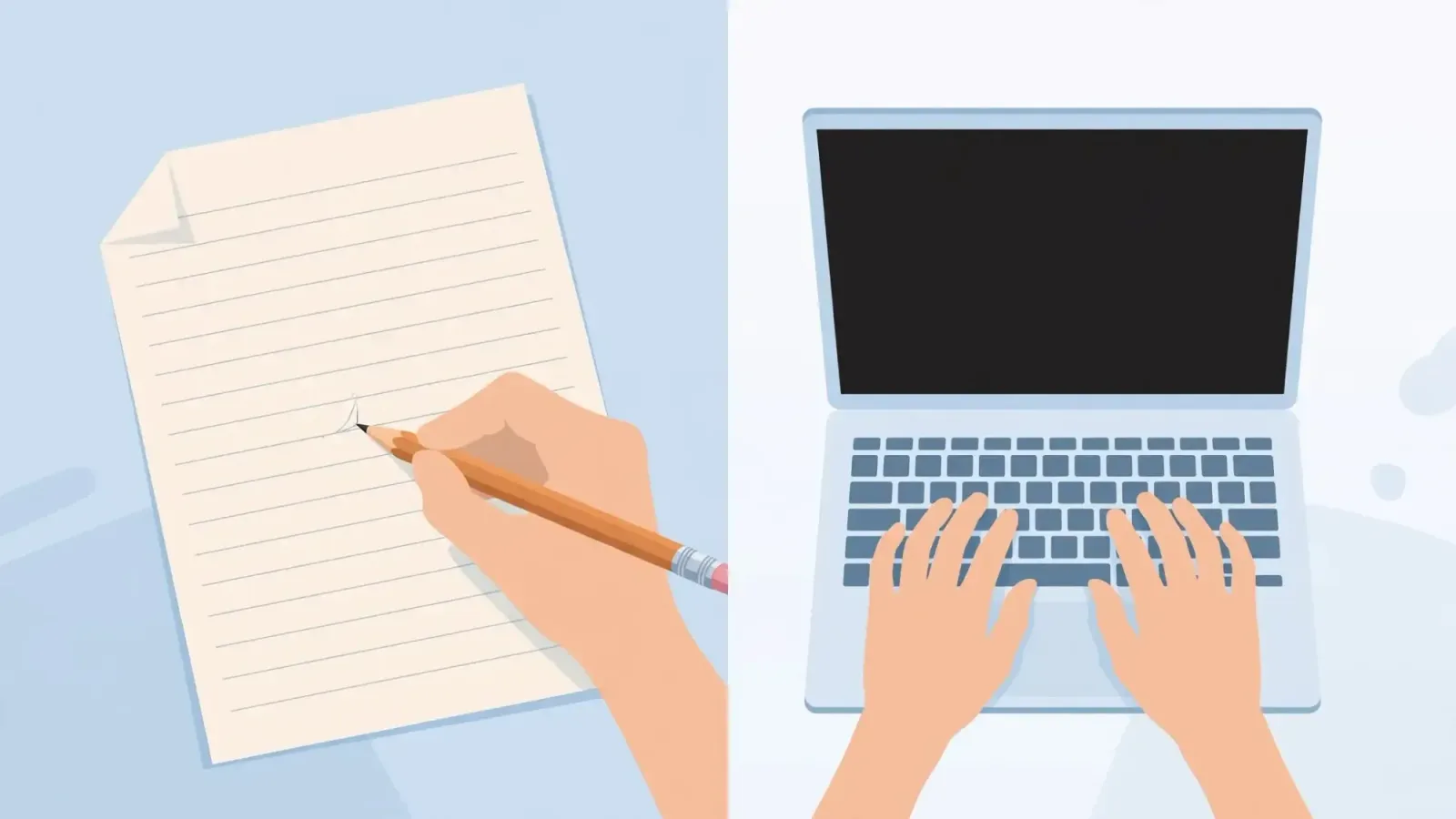
Choose typing for IELTS Writing if you can type about 10 words a minute or more while writing your own answer to an IELTS question, with few spelling mistakes. Choose Writing on Paper only if handwriting is clearly faster for you, your handwriting is easy to read, the option is offered at your test centre, and the organisation you're applying to accepts it. Your band score is worked out the same way in both modes, so the right choice is simply the one where you write your best essay in 60 minutes.
Since mid-2026 almost every IELTS test is on computer, but in selected countries you can still handwrite the Writing section. This guide compares IELTS Writing on paper vs computer point by point, shows where each mode costs or saves you marks, and gives you a 40-minute test you can do this week to decide.
What is IELTS Writing on Paper?
Writing on Paper is an option inside IELTS on computer, not a return of the old paper test. According to IELTS, it works like this:
- You take Listening and Reading on a computer, as normal. Speaking is still face to face with an examiner.
- In Writing, the two tasks appear on screen, and you get an answer sheet and a pen to write your answers by hand.
- Timing (60 minutes), task types and scoring are the same as the typed test, for both Academic and General Training.
- Results arrive within five days, and your Test Report Form does not say which mode you chose.
If you want the wider picture of how the whole test moved to computer, read our guide to what changed when IELTS became computer-only.
Can you choose Writing on Paper? Check this before anything else
Before you compare typing and handwriting, check that Writing on Paper is actually open to you. Three things can rule it out:
- Your country or test centre. IELTS only offers it in "selected countries". In India, for example, IDP opened it from 1 September 2026. If it doesn't appear when you book, it isn't available at that centre.
- IELTS for UKVI. If you need IELTS for a UK visa, the test is computer-only. There is no handwriting option.
- Australian visas. IDP Canada notes that the Australian Department of Home Affairs is still reviewing Writing on Paper, and advises anyone applying for an Australian study, work or migration visa to take the fully computer-based test. The same page says IRCC accepts it for Canadian PR and work permits.
There is one more rule to know. If you later use One Skill Retake for Writing, you must retake it in the same mode you chose the first time. A paper choice stays a paper choice.
IELTS Writing on paper vs computer: the differences that affect your score
The examiner uses the same four criteria in both modes: Task Achievement (or Task Response), Coherence and Cohesion, Lexical Resource, and Grammatical Range and Accuracy. What changes is how easy it is for you to show your best writing under time pressure.
| Typing on computer | Writing on Paper | |
|---|---|---|
| Word count | Automatic counter under the box | You count it yourself |
| Editing | Cut, copy, paste, delete and rewrite freely | Cross out; moving a paragraph means rewriting it |
| Spell-check | None | None |
| What you write with | Keyboard | A pen (no eraser) |
| Legibility | Always clear | Depends on your handwriting |
| Speed | Depends on typing skill | Depends on handwriting speed |
| Planning | Easy to plan as you go | Rewards planning before you start |
| One Skill Retake | Retake on computer | Retake on paper |
Word count: the counter vs counting lines
On computer, a live word counter sits under each answer, so you always know if you've passed 150 words for Task 1 and 250 for Task 2. On paper, you must judge it yourself, and counting every word wastes several minutes.
The fix is to measure your handwriting before the test. Write a few full lines in your normal size, count the words and take the average. If you write about 10 words a line, Task 1 needs about 15 lines and Task 2 about 25. On test day you count lines, not words.
Editing: typing is far more forgiving
Typing lets you move a sentence, rewrite a weak topic sentence or add an example in the middle of a paragraph in seconds. On paper, every change is a crossed-out word or an arrow, and a badly organised paragraph usually stays badly organised.
Research reflects this. A 2024 Cambridge review of 47 studies found that students with less computer experience planned more carefully when handwriting, because corrections are harder on paper. Typists planned less and edited more. Neither is wrong, but if you choose paper, a two-minute plan before you write becomes essential for Coherence and Cohesion.
Spelling and grammar: no help in either mode
The typed test has no spell-check, so a computer does not protect your spelling. Mistakes count against Lexical Resource and Grammatical Range and Accuracy in both modes.
There is one subtle difference. The same Cambridge review found that markers tend to notice spelling and punctuation errors more easily in typed text, while some errors are easier to overlook in handwriting. IELTS examiners are trained to mark both, but the safe lesson is simple: if you choose typing, leave three or four minutes to proofread.
Legibility: the hidden risk of handwriting
A typed essay is always readable. A handwritten one is only marked on what the examiner can read. Messy letters can turn a correct word into what looks like a spelling mistake, and unclear full stops can make your sentences look like run-on errors.
Write in normal upper and lower case, not all capitals. Capital letters and punctuation are part of accuracy, and all-caps hides whether you used them correctly.
Is IELTS Writing on Paper easier? What the research says
No, not on average. When IELTS announced the move to computer, it said its research found that scores were comparable across formats, both overall and within each band.
An earlier IELTS-funded study by Chan, Bax and Weir tested 153 candidates who wrote Academic Task 2 essays both on paper and on computer. Examiners' scores showed no significant difference for Task Achievement, Coherence and Cohesion, or Grammatical Range and Accuracy, and only a slight difference for Lexical Resource. The candidates' thinking and writing processes were also very similar in both modes.
The average hides individual differences, though:
- Typing skill matters. In the Chan study, candidates who were less familiar with computers tended to do slightly worse on computer.
- Weaker writers may do better by hand. The Cambridge review found that learners with weaker English often scored better when handwriting, while stronger learners scored about the same either way.
- Typed essays tend to be longer. That can help you reach the word minimum comfortably and develop ideas fully, which supports Task Response.
So the format won't change your band on its own. Your speed and accuracy in that format will.
Who should choose which? A quick guide
Type your essays if:
- You can type about 10 words a minute or more when writing your own IELTS answer, with good accuracy. That is enough for 150 and 250 words with time to plan and check. Typing tests measure copying, so their numbers (often 30–40 words a minute) are much higher and can't be compared.
- You like to write first and reorganise later.
- You tend to run short on words, and a live counter would help.
- You need IELTS for UKVI or an Australian visa.
Choose Writing on Paper if:
- You handwrite clearly and noticeably faster than you type, and there's no time to build typing speed before your test.
- You make many more spelling or typing mistakes on a keyboard than with a pen.
- You already plan your essays before writing, so editing tools add little.
- The option is offered at your centre and accepted by everyone you're applying to.
If you're unsure, typing is usually the better long-term choice. Typing speed improves quickly with daily practice, while editing tools and a word counter help on every essay.
The 40-minute test: decide with your own essays
Don't decide based on how a mode feels. Test it.
For a quick first check, try our free IELTS writing speed test. Write for 10 minutes by keyboard, then 10 minutes by hand, and compare your words per minute. Then do the full test below to compare accuracy and scores too.
- Pick two similar Task 2 questions on different topics, for example two "discuss both views" essays.
- Write one by hand with a pen, timed at 40 minutes. Stop when the time is up, even if you haven't finished.
- Type the other on a computer, also timed at 40 minutes, with spell-check turned off.
- Compare three numbers: the word count at 40 minutes, the number of spelling and grammar mistakes, and how many minutes you had left to check.
- Get both scored by criterion. Type up your handwritten essay exactly as written, including every mistake, and score both versions the same way.
If one mode gives you more words, fewer errors and a higher Coherence and Cohesion or Grammatical Range and Accuracy score, choose that mode. If the scores are close, choose typing, because it's available everywhere and gives you a word counter.
On PrepAsk's IELTS Writing practice, the writing box has a timer and live word counter and spell-check is switched off, just like the real computer test. Each essay gets an estimated band score with a score for each of the four criteria, plus grammar corrections, so you can compare your two essays fairly.
How to prepare for the mode you choose
If you choose typing
- Type every practice essay from now on. Never practise IELTS Writing in a word processor with spell-check on.
- Build speed by typing short timed answers to real IELTS questions, but practise accuracy first. A fast typist who makes ten typing errors per essay loses marks.
- Leave three or four minutes at the end of each task just to proofread.
If you choose Writing on Paper
- Practise with a pen, not a pencil, and get used to crossing out with a single neat line.
- Learn your words-per-line number so you can check length by counting lines.
- Spend two minutes planning each essay before you write: position, main ideas for each paragraph and one example each.
- Ask someone else to read one of your handwritten essays. If they stop to work out any word, slow down and write more clearly.
Either way, take at least one full timed test in the format you'll use, with Listening and Reading on screen first, as on test day. Writing after an hour of Listening and Reading feels very different from writing fresh.
The bottom line
IELTS Writing on paper vs computer is not a choice between an easy and a hard test. The scoring is the same, and IELTS research shows comparable scores. Choose the mode where you can write a well-planned essay of the right length with the fewest mistakes. For most candidates that is typing, especially with a few weeks of practice. For slow typists with clear handwriting, Writing on Paper is a fair alternative, if it's offered and accepted for your purpose.
Run the 40-minute test this week, decide, then practise only in that mode. Start with a timed essay in an IELTS mock test on PrepAsk and use your criterion scores to see which mode gives you the higher band.